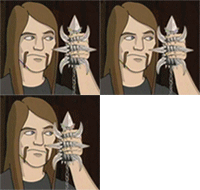
 . Here's the beginning of my creativity-free top 7:
7. Ylermi, from a poem of the same name by Eino Leino.
I could expound at some length about how brilliant the author was, but it should suffice to say he's popular enough in Finland that his birthday is a flag day. Oh, and BTW, over a thousand boys (and five girls) in Finland have been named after this character - whose name was made up by Leino just for this poem.
Ylermi's story is quite simple. He rides his horse to church one day and proclaims that he's awesome. The religious authorities (in this case, a wooden statue of Mary, later in the poem things like a stone statue of Jesus, a stone column, and a booming voice from the sky) seem to have something against his not dwelling in despair, so they try to mess up his life: "Now you will repent, after your house has burned down."
Ylermi doesn't repent, oh no he doesn't. He declares on the ashes that he'll get a new house built, a better one than this. And goes back to the church and booms at God not to tread on him. So what happens? The statue of Jesus tells him to repent, because his wife is now dead. Ylermi responds by saying it's time to get a new wife, and a better one this time. Again at the church, the walls tell him that his son has gone mad and it's time for him to start bending his knee - so Ylermi goes home, confirms that his son indeed is wild. His response? Why, he takes the bastard down with his own sword, and calls for a new, better one to be made. Then he rides back to the church, jumping in through the window (again looking awesome). He tells the Powers that Be that he slayed his own son, and no, he's still not out for mercy.
Well, at this point God decides he's had enough, so he pretty much tells the guy to go to Hell, and helpfully opens up the way for him. Ylermi, knowing he can't escape, wants to leave some sign of his defiance to the world, so he cuts off his (gauntleted) arm and throws it at the wall. Doing that, he declares (and I'm sorry I'm doing such a poor job of translating it) that a time will sooner come that men don't bow before death and go groveling to their graves, than the gauntlet let go of the stone.
And in the final line of the poem, of course, the gauntlet is still there.
Prometheus might have defied the gods in order to benefit mankind, but Ylermi impressed me more: Screaming straight in the face of the divine authorities simply because of sheer cussedness, and *about* sheer cussedness, which was unacceptable to religious morality. He's been called Nietzschean by many (and I swear I'll stop the arbitrary educated-sounding namedropping now), and for good reason: He just wants to have his own morality, one that's not the Christian morality tells him he's a horrible person and should regret his actions. That might not count as a very good kind of morality - but to me, it's still scores better than the "what God says is right" end of the continuum.
Of course, he's punished for all of this by death. How do you expect a story like this would work if he were to continue living? If he got what he wanted, it'd break the story, and if he didn't get it, he'd hardly have tried hard enough, and so would become a much weaker character. His martyrdom has meaning, if not for any other reason than its uncommonness.
Aand... well, I've got six more characters, but I realised I apparently have a bunch to say about a bunch of them (though not as long as this one because I won't have to translate their life stories), and this post is getting kind of lengthy for a random off-topic thing, so I'll tell you about the rest later. You're free to guess which characters from various works of fiction are in my top 6: I'll even go ahead and tell that two of them are human
 .