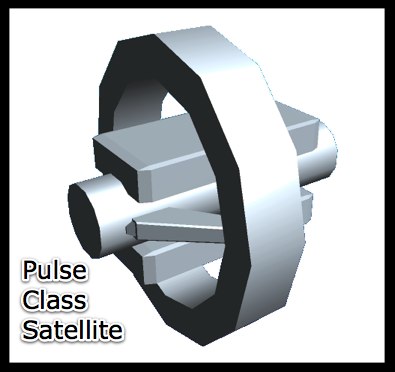
Diagram #3 of the Presentation[...]
Onto the the next point of business then. It is time that we made the development of the Ouroboros Array public. I'm pleased to announce that researchers over at the Liberty center have eliminated the flaw inherent in the Pulse-Class Satellite focus ring.
+There is a muffled question from the crowd that couldn't be heard on the tape+
My apologies director I wasn't aware that its function wasn't common knowledge yet. The Ouroboros Array was conceived as a planetary defense mechanism to obliterate or deflect space debris such as comets or meteors.
+Another muffled question+
Yes I use the word conceived for a reason. When the plans were presented to the CEO, there were some adjustments made. With few extra components added the Ouroboros was made to fire at the surface as well.
+Some angry protests can be heard+
Please gentlemen do not do me the insult of pretending to be appalled. In any case It will be classified as a DSI project so we wont even have the chance to test it without Ministry approval. Now moving on, I was asked to brief the Board on the basic workings of the Ouroboros.
The Ouroboros Array, thusly dubbed do it its similarities to the legendary World Snake that surrounded the world, is in effect a ion cannon. An ion cannon is fundamentally a kinetic energy weapon that relies on billions of high speed particles. Where the Ouroboros differs is that its significant radius allows for near light speed acceleration, 98.95% to be exact, and consequentially a much more powerful impact.
+could you give us an ides of how powerful a discharge would be?+
Well one of our physicist could probably explain it better then I, but the beam of particles would cause an area of localized fission at the impact point which mimics the effects of a hydrogen bomb except that the reaction is maintained for several seconds. I suppose a reasonable comparison would be dropping several hydrogen bombs one after the other.
+There are a few nervous coughs and the microphone is knocked causing feedback in the recording+
To achieve this the Array must be able to align a series of satellites which can accelerate and redirect the beam to the next. Our scientists have developed the Pulse-Class Satellite for the job. The majority of the structure consists of a giant Solenoid with interspersed electric fields to further accelerate the particles. The issue until now was that there was a noticeable amount of dispersion particles between satellites. This was solved however by adding a larger Solenoid ring, as you can see on this diagram, to redirect and focus the stray atoms.
+the sound of Lucard arranging his notes is heard+
That about wraps up the Pulse-Class. The reason for this briefing of course was because protocol requires you to vote on weather to implement this new satellite. The voting will take place after the meeting, though I doubt that the results will disappoint Lord Dine.
Our next point of business is the integration of [...]